Chapter 1 — Why Are U.S. Military Bases Concentrated in Okinawa?
Nearly seventy percent of all dedicated U.S. military facilities in Japan are located within a single prefecture: Okinawa. For many observers, this staggering imbalance raises an obvious question—why Okinawa? The answer lies not in any single cause, but in a layered history shaped by war, geopolitics, and postwar political inertia.
After the Battle of Okinawa ended in 1945, the prefecture was separated from direct Japanese administration and placed under U.S. military governance. During this period, vast tracts of land were requisitioned—often forcibly—from local residents to construct airfields, weapons depots, logistics hubs, and training facilities. Entire communities were displaced, and farmland was converted into fenced military compounds. By the time Okinawa was returned to Japanese sovereignty in 1972, the basic framework of the American military network across the island had already been cemented.
Upon reversion to Japan, most of these installations remained operational. While there were public discussions about relocating portions of the military presence to the mainland, those proposals quickly met strong opposition from prefectures unwilling to host new bases. Politically, relocating facilities proved costlier than maintaining the status quo—especially since Okinawa already possessed fully developed infrastructure.
Beyond domestic politics, Okinawa’s geographic position added strong strategic justification. Located near the Taiwan Strait, the Korean Peninsula, and critical South China Sea routes, the island is one of the most tactically advantageous military outposts in the Pacific. Airbases in Okinawa allow rapid response across East Asia—capabilities that cannot easily be replicated elsewhere.
This convergence of historical land acquisition, political resistance elsewhere in Japan, and Okinawa’s strategic geography resulted in the long-term concentration of U.S. forces on the island—a reality that persists to this day.
Chapter 2 — The Major U.S. Military Bases of Okinawa
The island of Okinawa contains a dense network of military installations serving the U.S. Air Force, Marine Corps, Navy, and joint command structures. The highest concentration lies in the central region of the main island, where urban neighborhoods and bases often exist side by side with little physical separation.
The most prominent facility is Kadena Air Base, the largest U.S. Air Force installation in East Asia. Kadena hosts fighter squadrons, reconnaissance aircraft, refueling tankers, and logistical support units. Its dual runways operate continuously. Surrounding residential areas in Chatan, Kadena Town, and Okinawa City endure persistent aircraft noise, making community relations an ongoing challenge.
Encircling Kadena is the Camp Zukeran complex, commonly referred to as Camp Foster. This area contains command headquarters, medical centers, and housing districts for military families. Camp Foster effectively functions as a full-service American suburban enclave—complete with supermarkets, schools, and recreation facilities financed and managed internally by the U.S. military.
North of these installations lies Camp Hansen, a vast Marine Corps training ground surrounded by forested areas. Although distant from major residential centers, live-fire exercises occasionally raise safety and noise concerns among nearby towns.
To the south is the highly controversial Marine Corps Air Station Futenma, situated directly within the dense urban fabric of Ginowan City. Its location has earned it the reputation as one of the most dangerous airbases in the world, due to helicopter flight paths running over schools, hospitals, and public housing. Plans to relocate Futenma to Henoko have remained politically deadlocked for decades.
Naval logistics operate primarily through the Naha Port Facility and the White Beach area near Uruma, serving as docking and supply locations for visiting vessels.
Collectively, these bases form not merely a military system but an entire parallel living infrastructure that supports tens of thousands of U.S. personnel and their families stationed across Okinawa.
Chapter 3 — Where Do Americans Live in Okinawa?
Despite the existence of on-base housing, a significant proportion of American service members and civilian contractors choose—or are required—to live off-base, integrated into local communities under housing allowance programs.
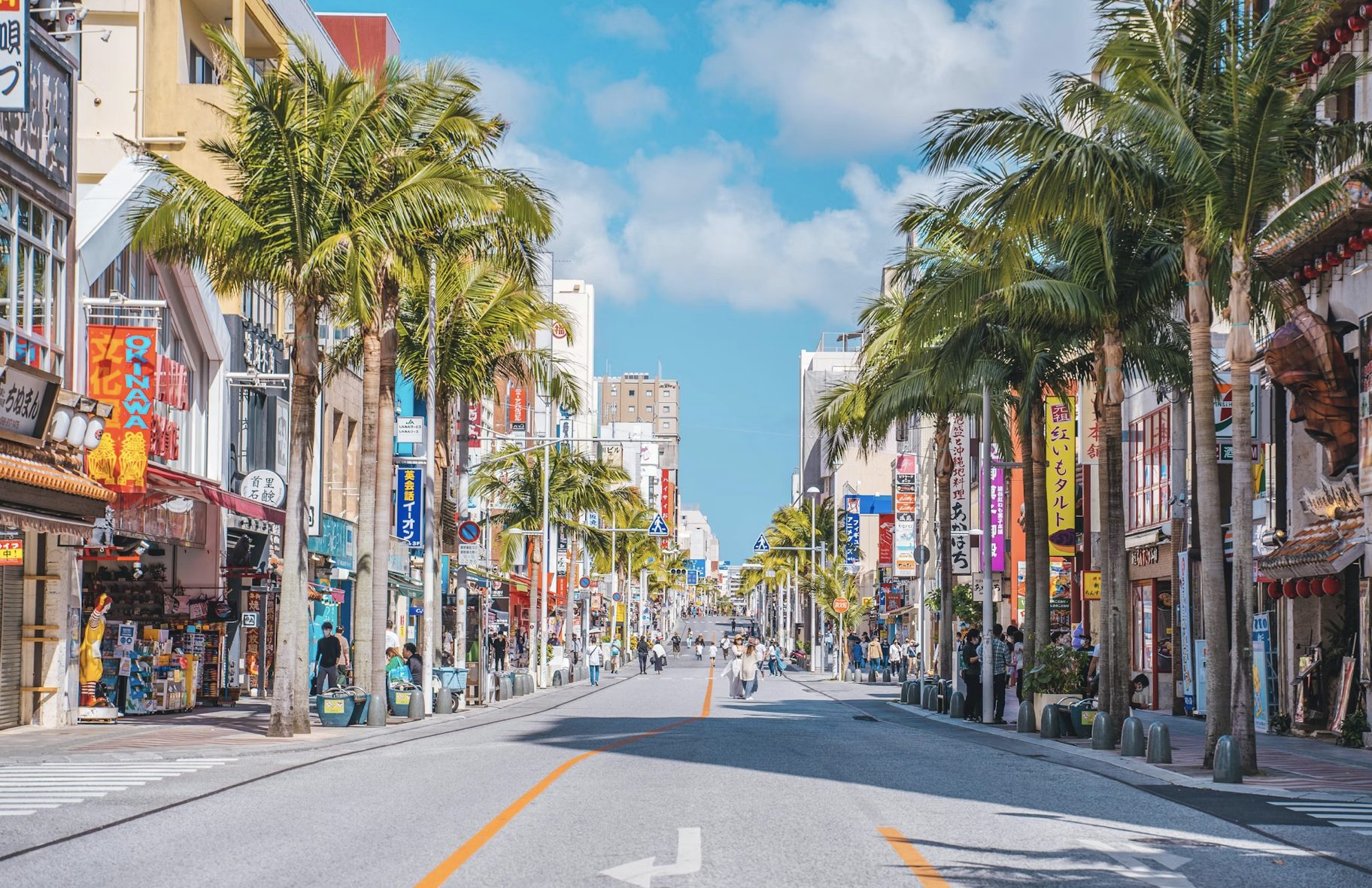
The most visually distinctive of these neighborhoods is Chatan Town. Centered around the famous American Village shopping and dining district, Chatan has become the symbolic heart of Okinawa’s international community. Streets lined with English signage, American-style cafes, beachfront condos, and large Western-style apartment buildings dominate the skyline. Many units are fully furnished, reserved primarily for foreign tenants, and feature amenities such as parking for multiple vehicles and larger living spaces uncommon in mainland Japan.
Kadena Town attracts more transient residents—young enlisted personnel living short-term assignments. Housing stock here is characterized by modest rental homes and apartment blocks catering to single residents or couples without children.
Okinawa City, once known as Koza, offers the most organically developed U.S.-influenced social environment. Bars, live music venues, and mixed-culture eateries stretch across streets once frequented exclusively by servicemembers decades ago. Unlike tourist districts, Koza remains a genuine residential-commercial blend where bilingual signage and daily English conversation retain practical relevance rather than novelty.
Ginowan City hosts numerous military families drawn by proximity to American schools and support facilities. Family-sized condominiums and detached houses are common in this area, particularly around international school routes and supermarket districts catering to Western grocery preferences.
Collectively, these cities are home not only to Americans but also to multinational households and mixed-nationality families. Children raised in these communities commonly grow up bilingual and culturally fluid—an experience rarely found elsewhere in Japan. Okinawa’s American residential zones thus form some of the most multicultural urban neighborhoods in the country.
Chapter 4 — American Housing Systems in Okinawa
For most Americans stationed in Okinawa, housing is provided through a system fundamentally different from typical Japanese rentals. Military personnel receive a dedicated Overseas Housing Allowance (OHA), enabling them to rent off-base homes without bearing personal financial risk related to local price fluctuations. This allowance covers rent up to a specified ceiling while utilities are reimbursed separately based on household size.
As a result, landlords in designated “foreigner-friendly” districts have tailored properties specifically to American tenants. Homes are significantly larger than standard Japanese apartments, commonly ranging from 80 to 130 square meters, with three-bedroom layouts, Western kitchens, full bathtubs, and dedicated parking for two vehicles. Many properties come pre-furnished or semi-furnished and include modern appliances.
Security standards differ as well. Properties intended for American tenants are fitted with reinforced doors, exterior lighting, and in some cases enclosed yards—features uncommon in Japanese residential architecture. Management companies often employ bilingual staff to mediate tenancy issues and assist with inspections required by U.S. housing officers before lease approval.
While on-base housing offers gated security, American-style school access, and integrated utilities, waiting lists are common, pushing many families toward civilian rentals instead. This mixture results in broad integration between American residents and Japanese communities.
Chapter 5 — Employment Structures of the American Community
The American population in Okinawa falls into three primary employment categories: active-duty military personnel, civilian Department of Defense employees, and contract workers.
Active-duty members serve across air, marine, naval, and intelligence branches. Deployments rotate every two to three years, which explains the transient nature of many American neighborhoods. Training programs, maintenance operations, flight crews, and logistics support represent the majority of enlisted positions.
Civilian government personnel include teachers, medical staff, engineers, logistics administrators, and IT specialists serving on longer multi-year postings. These residents often integrate more deeply into local communities due to extended stays.
Private contractors support functions such as base construction, vehicle maintenance, telecommunications, and security. Many are employed through multinational firms under Department of Defense tenders.
In parallel, smaller numbers of Americans work outside military systems—predominantly within international schools, tourism, language education, and dining businesses oriented toward foreigners. These workers typically live under Japanese work visas and experience the conventional challenges of foreign residence: language barriers, guarantor requirements, and housing screening.
Chapter 6 — Economic Impact on Okinawa
The presence of U.S. military installations injects billions of yen annually into Okinawa’s economy. The most direct inflow is through base employee wages and OHA-driven rent spending. Entire property management sectors exist solely to service American leases.
Local service industries—supermarkets, automobile dealers, maintenance contractors, restaurants, and recreation venues—benefit heavily from American patronage. English-language hospitals, dental clinics, and cultural organizations have emerged to meet ongoing demand.
However, dependence introduces vulnerability. Communities built around base economies face stagnation when deployments shift or construction contracts expire. Younger Okinawans increasingly pursue tourism or mainland relocation to avoid limited career horizons tied to military commerce.
The tension between stable income and economic diversification remains a central development debate across the prefecture.
Chapter 7 — Cultural Integration and Daily Exchange
American cultural influence permeates Okinawa more visibly than anywhere else in Japan. Large burgers, roadside diners, live music venues, English signage, and Western clothing stores blend seamlessly into the urban environment.
Daily exchange exists quietly through routine activities: children attending bilingual schools, mixed-nationality families raising bicultural households, volunteer participation in coastal cleanups, and church-community gatherings open to Japanese residents.
Yet cultural isolation also persists. Some Americans socialize primarily within base communities, while Japanese residents may perceive foreigners as temporary visitors rather than integrated neighbors. Language obstacles reinforce separation, particularly for newcomers with limited Japanese proficiency.
Despite this divide, second-generation mixed families form powerful cultural bridges. Their presence has transformed education networks, medical accessibility, and community norms across portions of central Okinawa.
Chapter 8 — Conflict, Incidents, and Legal Challenges
Coexistence has not been without strain. Noise complaints triggered multiple lawsuits by residents surrounding Kadena Air Base. Aircraft accidents, while rare, create population anxiety, especially around densely populated Ginowan.
Occasional criminal incidents involving U.S. personnel generate intense public scrutiny. Legal jurisdiction under the Status of Forces Agreement (SOFA) complicates prosecutions and creates perceptions of unequal justice.
Municipal protests and civil society movements regularly demonstrate opposition to base operations, particularly related to the stalled relocation of Futenma. These tensions shape local political discourse and influence national elections.
Chapter 9 — Base Relocation and Future Planning
The most contentious issue remains the proposed relocation of Futenma Air Station to Henoko, an environmentally sensitive coastal area. Okinawan voters consistently oppose relocation, while Japan’s central government continues advancing construction citing bilateral security obligations.
Simultaneously, partial land returns have enabled redevelopment projects producing shopping districts, public housing, and industrial zones. These urban transformations represent efforts to convert military real estate into civilian economic assets.
However, large-scale reduction of the American presence remains politically improbable due to regional security conditions.
Chapter 10 — Living in Okinawa Today
For residents, daily coexistence with bases has normalized. The sound of fighter jets forms part of the background rhythm of life. American supermarkets sit beside Japanese convenience stores. English phrases are commonly heard on playgrounds and buses.
Life in Okinawa is defined neither purely by military occupation nor by tourism—but by the layered coexistence of cultures shaped by history. Opportunities for cultural exchange are immense, yet unresolved tensions remain part of the social landscape.
Okinawa stands as a living example of long-term cross-cultural convergence forged under complex circumstances—neither fully harmonious nor irreparably divided.